
Specifically, the supervision reforms that took effect in 2026 provide structural safeguards. By mandating explicit written policies, strict compliance clocks, and clear succession plans, the law protects brokers from burnout-driven errors, personal safety risks, and catastrophic liability exposure. Let us examine how complying with Oregon law can become your ultimate burnout-prevention strategy.
The Regulatory Landscape: Structuring Supervision
Historically, real estate supervision could feel abstract, with Managing Principal Brokers relying on informal oversight. Legislation passed in 2025 changed this landscape by introducing strong supervision reforms. Central to this reform, which took effect on January 1, 2026, is the requirement for Managing Principal Brokers to maintain and enforce explicit written policies, procedures, and systems to supervise professional real estate activity. These reforms eliminate ambiguity in the supervisory chain of command. The new mandates ensure every professional real estate activity is tethered to a specific, documented supervisory system. By forcing the creation of these systems, the state pushes brokerages to operate as mature businesses. This maturation process is the ultimate antidote to burnout. When a broker knows there is a documented, enforced system backing them up, they can operate with confidence. When a brokerage relies solely on the memory of an individual Managing Principal Broker, the system is brittle. If that broker becomes exhausted, the compliance structure falters. By mandating comprehensive written systems, the 2026 framework forces brokerages to build reliable infrastructure. These written procedures distribute the workload, standardize workflows, and create automated fail-safes. The framework legislates a sustainable way of doing business, shifting the burden from individual endurance to structural reliability.
The Unique Vulnerability of Sole Proprietor Principal Brokers
While much regulatory discussion centers on Managing Principal Brokers managing teams, sole proprietor principal brokers face a distinct set of burnout risks. Solo practitioners do not have associate brokers to cover showings, nor do they have administrative staff to delegate compliance tasks to. They wear every hat simultaneously, bearing the entire weight of state compliance, client communication, and transaction management. For these independent professionals, exhaustion creates a single point of failure for the entire business. Furthermore, proactive succession planning and the utilization of temporary authorization rules are essential survival mechanisms that prevent temporary fatigue from turning into permanent license discipline.
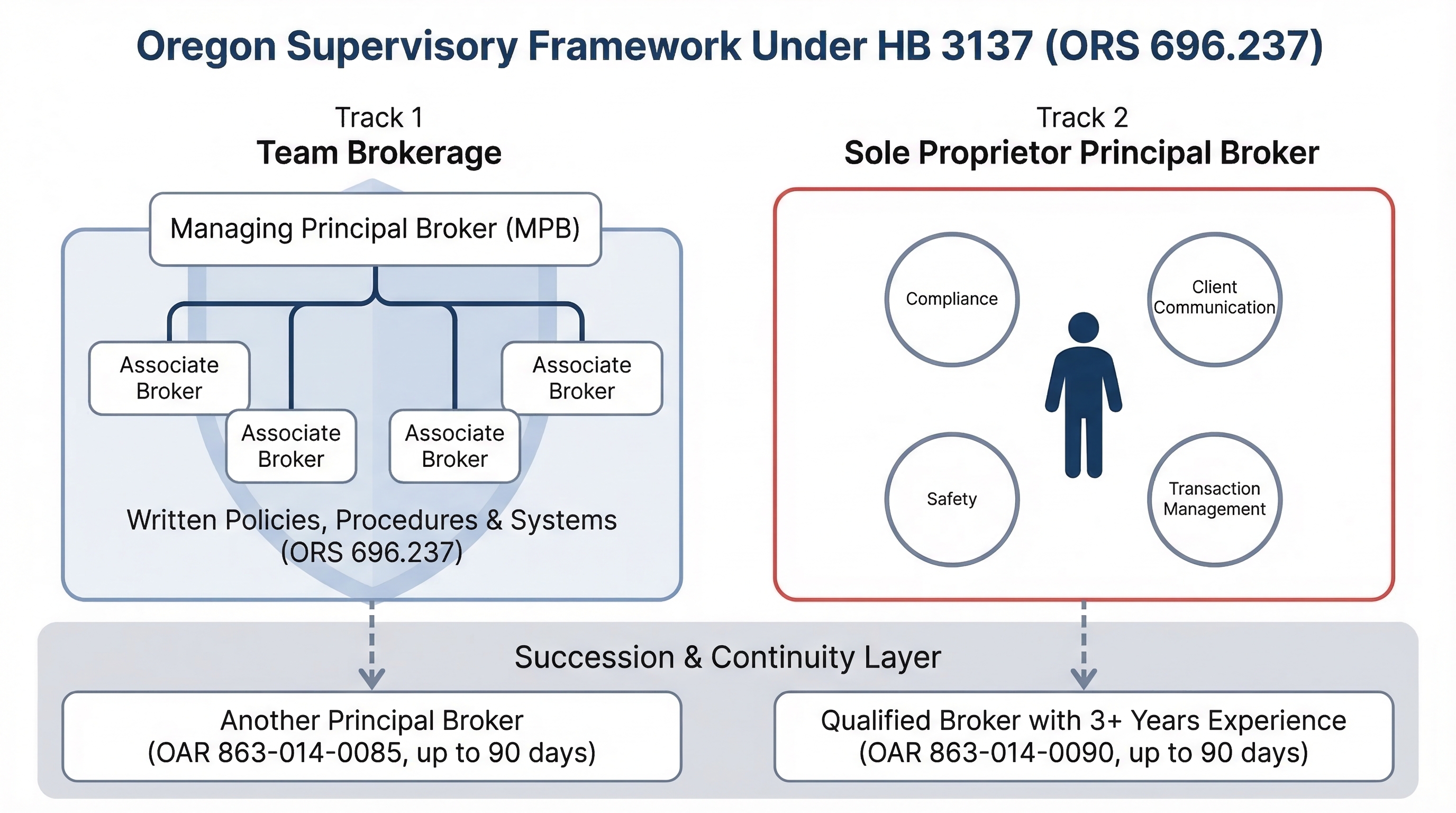
Under Oregon's 2026 reforms, written supervisory systems protect team brokerages structurally. Sole proprietors must proactively activate succession rules to avoid becoming a single point of failure.
How Burnout Becomes Liability: The Ticking Compliance Clocks
When mental and physical exhaustion set in, cognitive function drops. A burned-out broker rarely commits intentional fraud. Rather, they make careless mistakes. Under Oregon law, these burnout-driven errors directly trigger discipline. To understand how quickly exhaustion becomes liability, look at the strict compliance clocks embedded in the state's administrative rules. When a broker is overwhelmed, these ticking clocks become landmines:
- Document Transmittal: Brokers must transmit generated documents to their Managing Principal Broker within three banking days. An exhausted broker who delays uploading a signed disclosure falls out of compliance instantly.
- Earnest Money Delivery: A tired broker who fails to deliver a promissory note or physical check to the escrow depository within the three-banking-day window violates the rule and compromises consumer trust.
- Managing Principal Broker Review: The burden shifts to the Managing Principal Broker with the seven-banking-day review rule. They must review and initial every document of agreement within seven banking days. A burned-out Managing Principal Broker who lets files pile up over the weekend is structurally out of compliance.
- Trust Accounts: The Managing Principal Broker holds strict liability for all deposits and disbursements in the clients' trust account. If both the broker and the Managing Principal Broker are fatigued, the fail-safes break, and the resulting trust account liability can be financially devastating.
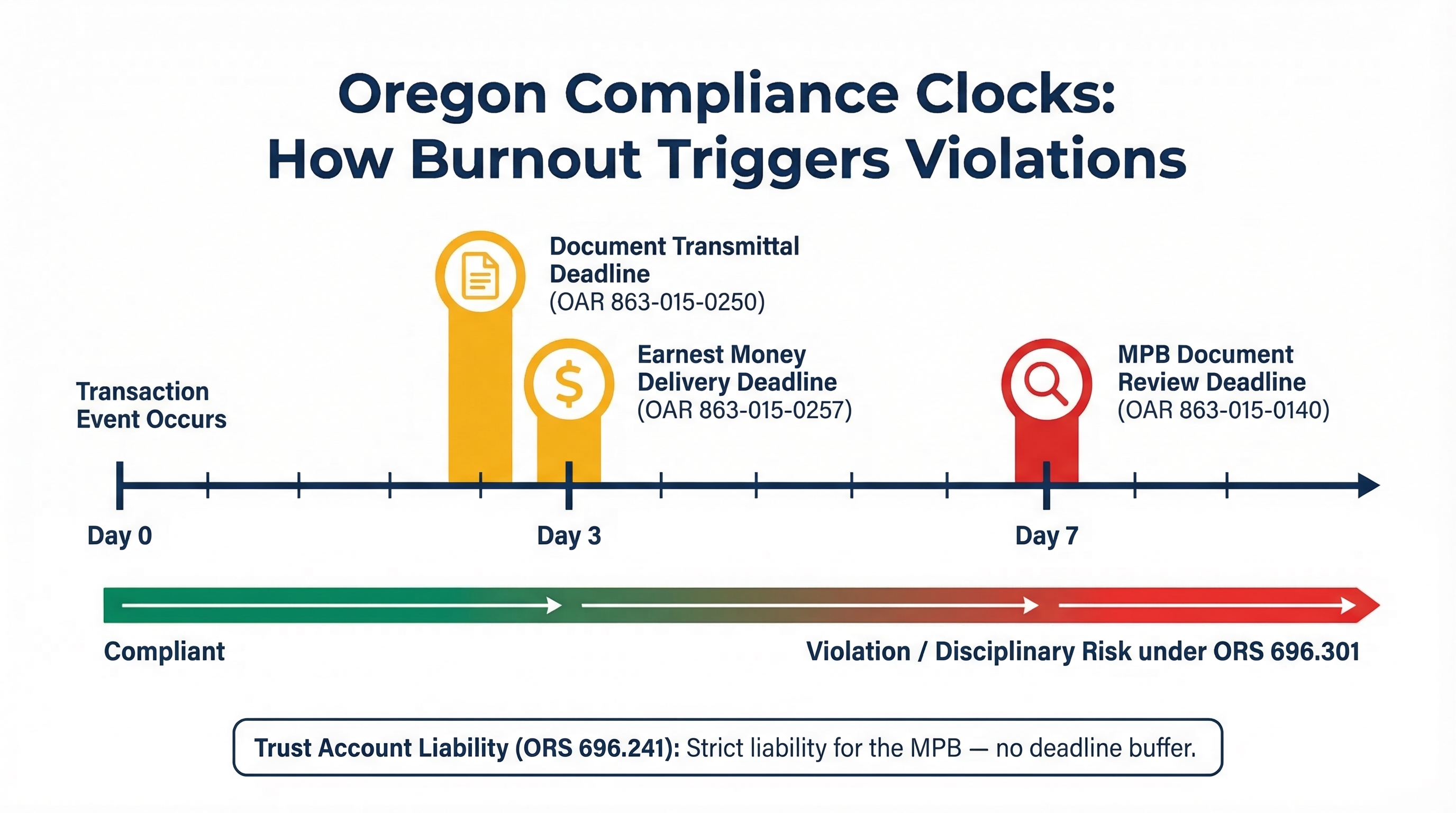
Oregon's compliance clocks leave no margin for burnout-driven delays. Each missed deadline is an independent ground for discipline.
Personal Safety as a Compliance Framework
Burnout threatens a broker's physical safety. Exhausted professionals are prone to rushing, ignoring red flags, and cutting corners. The state regulatory agency has consistently published safety guidance emphasizing a core rule: "Never meet a new client alone." The written-policy mandate gives brokerages a natural, enforceable vehicle to embed physical safety protocols into standard operations. By writing safety requirements into the brokerage's official manual, Managing Principal Brokers elevate personal safety from a "best practice" to a mandatory compliance system. If the brokerage's written policy requires a verified ID before a showing, the individual broker no longer has to feel awkward setting boundaries. They can simply state, "It is our mandatory brokerage policy." This ensures that the pressure to close a deal never overrides the protocols that keep agents alive.
Continuity and Succession as Wellness Infrastructure
A primary driver of burnout is the isolating fear that if a broker takes a vacation, falls ill, or steps away to recharge, their business will collapse. Oregon's regulatory framework combats this dynamic by providing explicit rules for business continuity and succession. Under state rules, a Managing Principal Broker can authorize another principal broker to control and supervise their business for up to 90 days. If a sole Managing Principal Broker does not have another principal broker available, the rules allow them to authorize a real estate broker with at least three years of active experience to temporarily supervise for up to 90 days. However, Managing Principal Brokers, especially sole proprietors, can and should use these 90-day authorizations as tools for sustainability. Knowing the state provides a legal mechanism to pass the baton means a Managing Principal Broker can take a genuine, unplugged sabbatical. By formalizing hand-offs, brokerages ensure clients are protected, compliance clocks are monitored, and the primary broker can recover from the grind of the industry.
Practical Steps: Turning Regulation into a Burnout-Prevention Tool
Understanding the protective nature of Oregon's regulations is only the first step. Executing them requires intentional practice. Here are actionable steps:
- Audit and Automate the Clocks: Utilize transaction management software that automatically alerts the Managing Principal Broker and the broker when a document is approaching its transmittal or review deadline.
- Codify Safety into Compliance: Update the required written policies to include strict safety checklists. Make the state's official safety guidance mandatory. Treat safety violations with the same seriousness as an earnest money violation.
- Pre-Draft the 90-Day Succession Plan: Identify brokers with three years of experience who qualify for temporary supervision. Train them, prepare the authorization forms in advance, and normalize the practice of Managing Principal Brokers taking disconnected rest while the temporary supervisor takes over.
- Reframe Training: When conducting compliance training, do not just threaten agents with disciplinary consequences. Explain that compliance is not a punishment. It is a boundary that protects their peace of mind.
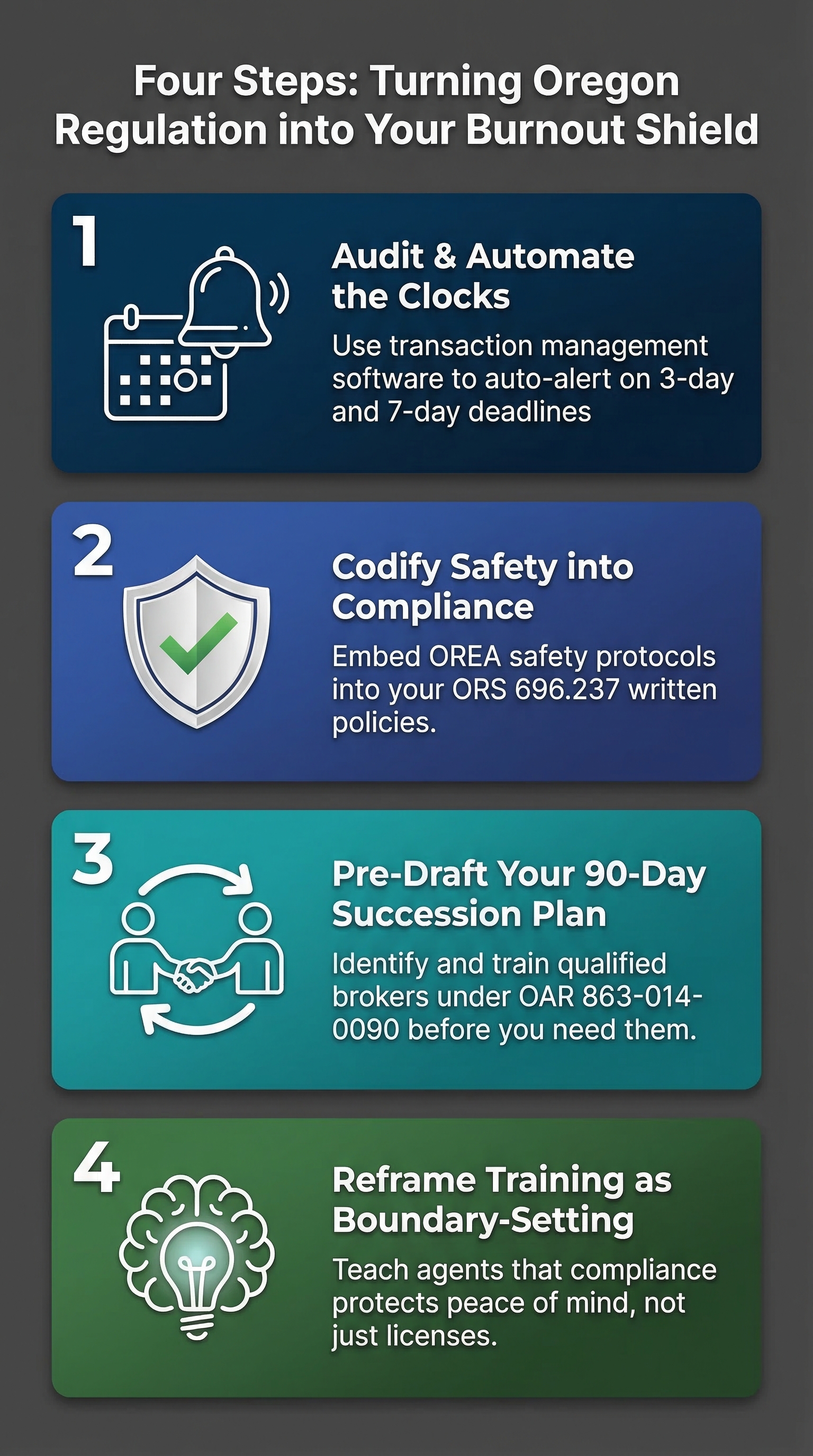
Compliance is not punishment. It is infrastructure. These four steps transform Oregon's regulatory mandates into a sustainable practice framework.
Conclusion
The narrative that real estate requires endless sacrifice is outdated and dangerous. Burnout is a silent liability that erodes an agent's standard of care, jeopardizes their physical safety, and puts the entire brokerage at risk of severe disciplinary action under Oregon law. By looking closely at the state's regulatory landscape, we find a comprehensive blueprint for sustainable business. Oregon's real estate regulations are a built-in safety net, engineered to ensure that workloads are distributed, errors are caught early, and brokers have the structural permission to step away and recharge.
Legal Disclaimer
The information provided in this article is for educational and informational purposes only and does not constitute legal advice. While every effort has been made to ensure the accuracy of the regulatory interpretations discussed herein, real estate laws and administrative rules are subject to change. Readers should not act upon this information without seeking advice from a licensed Oregon real estate attorney. For guidance on specific compliance questions, please contact the state regulatory agency directly or consult your managing principal broker.